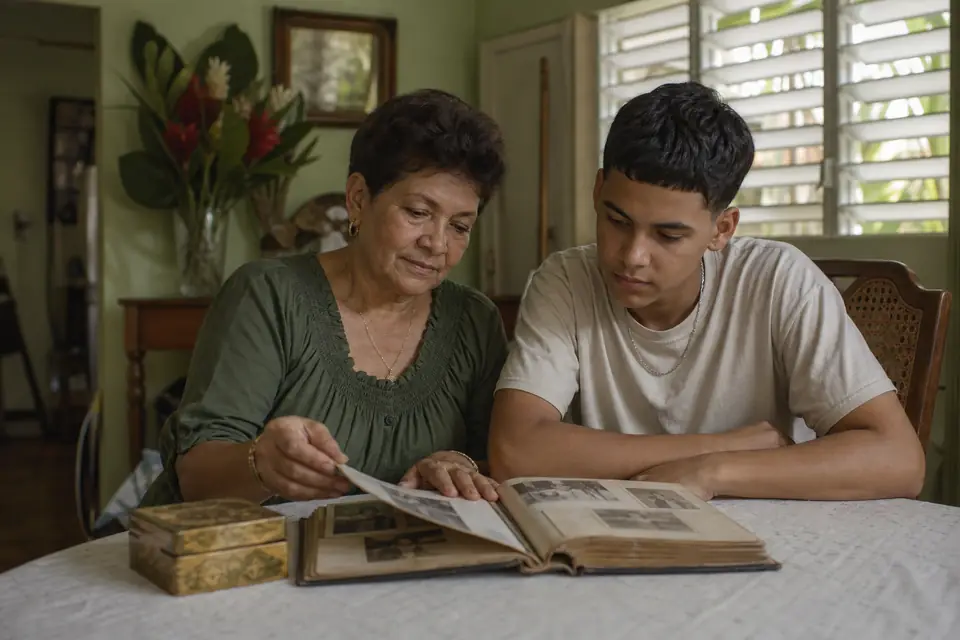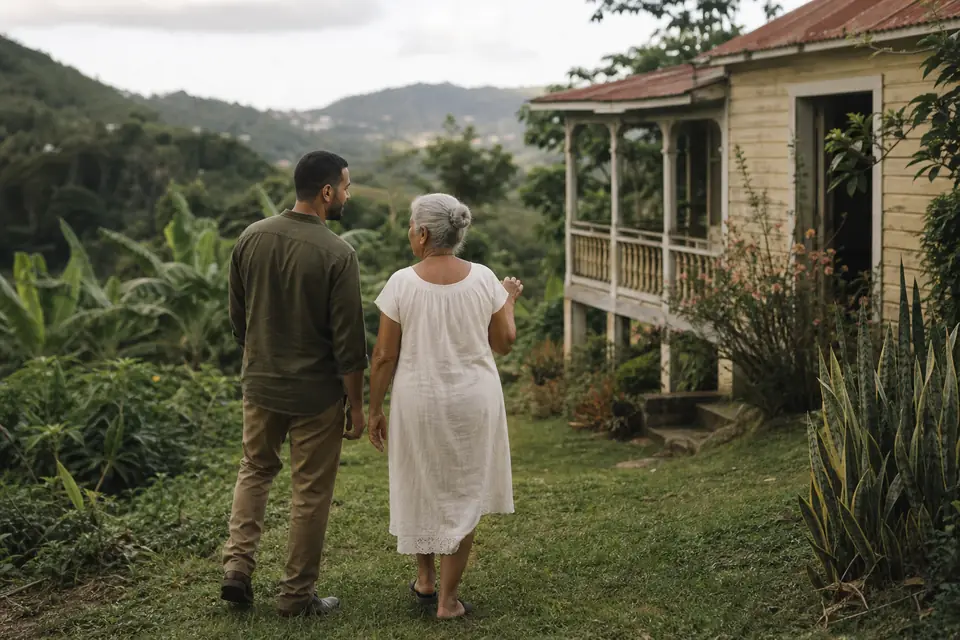
Many Puerto Rican families have a piece of land, a lot or a house that everyone calls "the family's," but that is still in the grandfather's or grandmother's name on paper. No one settled the estate when they died, and over the years some of their children died too. Today there are grandchildren and great-grandchildren on the island and off it, and no one is quite sure where to start.
It can be resolved, but it takes patience and order. This guide explains the logic of the process.
A quick reminder: the causante is the person who died, whose estate it is; the sucesión is the group of their heirs; the declaratoria de herederos (declaration of heirs) is the document that says who inherits when there was no will; and the relevo is the certificate from the Departamento de Hacienda ("Hacienda," Puerto Rico's Treasury) that cancels the lien on the estate's assets.
Chained estates: one estate inside another
Each death opens its own estate. If the grandfather died, then the grandmother, and then one of their children, there are three separate estates, each with its own heirs, documents and rules.
If an heir died after the causante without settling the estate, their right to accept or refuse it passes to their own heirs (Art. 1586 of the Código Civil, the Civil Code). That is why that uncle's children come into the grandfather's estate through their father's estate.
If a child died before the causante, a different rule applies: the right of representation (derecho de representación). That child's descendants inherit directly from the grandfather in the child's place (Arts. 1611–1612). See children, grandchildren and representation.
The difference matters because it changes who signs and which documents you need. For example, the transfer under Art. 1586 also brings in the heirs of the uncle who died, which may include his widow or widower.
Which code applies to each death
The rule depends on the date of each death (Art. 1816):
| Date of death | Code that applies | Some differences |
|---|---|---|
| Before November 28, 2020 | 1930 Civil Code | Legítima (forced share) of two-thirds, including a third for mejora (betterment) (Art. 737); the widow or widower had a share in usufruct (Art. 761) |
| From November 28, 2020 | Código Civil de Puerto Rico de 2020 (2020 Civil Code) | Legítima of one-half; the spouse inherits outright a share equal to each child's (Arts. 1623–1624 and 1721) |
The same family may have deaths under both codes. Each estate is settled under the code in force on its date. See 2020 Civil Code vs. the 1930 Code.
The land in Utuado was community property (ganancial) of Don Ramón and Doña Rosa. They had four children. None of them had a will, and we assume everyone accepted.
- Don Ramón died in 1988 (1930 Code). Doña Rosa kept her community-property half. Don Ramón's half passed to his four children, 1/8 of the land each, and Doña Rosa also had her share in usufruct, which ended when she died.
- Doña Rosa died in 2009 (1930 Code). Her half passed to the four children, another 1/8 each. Each child now holds 1/4 of the land.
- Pedro, one of the children, died in 2022 (2020 Code), leaving his widow, Luz, and two children. What a person inherits is normally their separate property, so his quarter passes into his estate and, without a will, is divided equally among Luz and his two children (Art. 1721): 1/12 of the land each.
That is three estates. To sell the land, Don Ramón's three living children would have to sign, plus Luz and Pedro's two children.
One succession document for each causante
Will or declaration. For each person who died, you need to find out whether they left a will. You do that with the certificate from the Wills Registry (see how to find out whether there is a will). If there was no will, you need a declaration of heirs for that person.
Successive declarations. In the example, there would be three declarations: one for Don Ramón, another for Doña Rosa and another for Pedro. Each one requires the death certificate, the heirs' birth certificates, the marriage certificate when it applies and the negative will certificate (showing no will was found).
Start by gathering everyone's documents. Draw a family tree with dates of birth, marriage and death. It is the most useful tool you can give the notario (in Puerto Rico, a notary is an attorney) or the lawyer.
One relevo for each causante
The Hacienda return depends on the date of each death:
| Date of death | Form |
|---|---|
| Before January 1, 1969 | SC 2789 |
| 1969 to 2010 | SC 2800 or SC 2800 A |
| 2011 to 2017 | SC 2800 B |
| From January 1, 2018 | SC 2800 C (information return, no tax) |
The old rules still apply to old deaths. For deaths before 2018, the tax laws of that time govern, and you use the return that corresponds to that date. The return for deaths since 2018 is due within 12 months; for deaths from 1969 to 2017, the deadline was 9 months. If the deadline has passed, ask a professional how to get caught up.
Everything goes through SURI. Returns for deaths before 2011 are prepared on paper, scanned and uploaded to SURI, Hacienda's online system (Carta Circular de Rentas Internas 18-19). See the estate information return and the Hacienda relevo.
The CRIM. The return requires a certificate from the CRIM (Municipal Revenue Collection Center) showing no debt. Property tax for the current year and the 5 prior fiscal years is a first lien on the property (Código Municipal, Art. 7.057). Forgotten land may have accumulated debt, so ask for a statement of account early.
The Property Registry: one step after another
Successive chain of title (tracto sucesivo). To record what the grandchildren receive, the grandfather's title and his heirs' hereditary rights must be recorded first, and then each transfer in order (Ley 210-2015, Art. 134). If the declaration or the will does not describe the property, a written request called an instancia is filed with it (Art. 126). See recording inherited property.
If the land was never recorded. Some properties never made it into the Registro de la Propiedad (Property Registry), especially in the countryside. In general terms, an expediente de dominio is a court proceeding to prove ownership and record a property that does not appear in the Registry, and in certain cases to restore an interrupted chain of title. It requires proof of how the property was acquired and may require plans and certificates. A lawyer can tell you whether it applies to your case.
When someone else has been in possession for years. The action to claim an inheritance does not expire, but that does not prevent someone from acquiring specific property by usucapión (acquisitive prescription), that is, by possessing it for the time and in the manner the law requires (Art. 1593). If a relative or a neighbor has occupied part of the land for a long time, get advice soon.
Land that has never been surveyed
What a survey (mensura) is. It is the measurement of a piece of land by a surveyor, which produces a plan showing its area (cabida) and its boundaries (colindancias). Many old properties have vague descriptions, such as "bordering the creek" or "bordering so-and-so's land."
When you need one. If you plan to sell, divide the land into lots or file an expediente de dominio, you will most likely need an updated plan. Dividing land into lots, known as segregation (segregación), also requires permits under the permit regulations in force. Talk to a licensed surveyor and the notario before promising a lot to anyone.
How to move forward without getting lost
- Draw the family tree with all the dates.
- Look for the titles: deeds, Registry certificates and the CRIM cadastral number.
- Request will certificates for each causante.
- Decide together what you want: sell, have one person buy out the others or divide. See dividing the estate.
- Notify the CRIM of the change of owner when you acquire the property; the law gives you 30 days (Código Municipal, Art. 7.052).
Frequently asked questions
Do we have to settle every estate, or can we skip straight to the grandchildren?
Under the rule of successive chain of title, each estate has to be settled in order so the chain of title is complete. Sometimes they can be processed in parallel, but none can be skipped.
Did we lose the right because so many years have passed?
The action to claim an inheritance does not expire (Art. 1593), and neither does the action to request partition (Art. 1205). But someone may have acquired specific property by usucapión. Get advice soon if another person is occupying the property.
Do we have to pay inheritance tax for the grandfather's death?
It depends on the date of his death. For deaths since 2018, there is no estate tax in Puerto Rico; for earlier deaths, the laws of that time apply. In every case, you need the corresponding return and relevo to be able to sell or record the property.
What happens if we cannot find one of the heirs?
Their right still exists, and their signature is needed to sell the whole property. A 2026 bill, P. del S. 1340, proposes a procedure for heirs who cannot be located, but it is not law. In the meantime, seek professional guidance.
Sources
- Código Civil de Puerto Rico de 2020, Arts. 1586, 1593, 1611–1612, 1721 y 1816. bvirtualogp.pr.gov
- Código Civil de Puerto Rico de 1930 (derogado), Arts. 737 y 761. bvirtualogp.pr.gov
- Departamento de Hacienda, Instrucciones del Modelo SC 2800 C. hacienda.pr.gov
- Departamento de Hacienda, Carta Circular de Rentas Internas 18-19 (caudal relicto en SURI). hacienda.pr.gov
- Ley del Registro de la Propiedad Inmobiliaria (Ley 210-2015), Arts. 126, 131 y 134. lexjuris.com
- Código Municipal de Puerto Rico (Ley 107-2020), Arts. 7.052 y 7.057. lexjuris.com
CaudalRelicto.com is an independent guide. It is not Puerto Rico's Departamento de Hacienda, the courts or any government agency. This page is general information, not legal advice from an attorney who knows your case. Names and figures in examples are hypothetical. Found an error? Tell us.