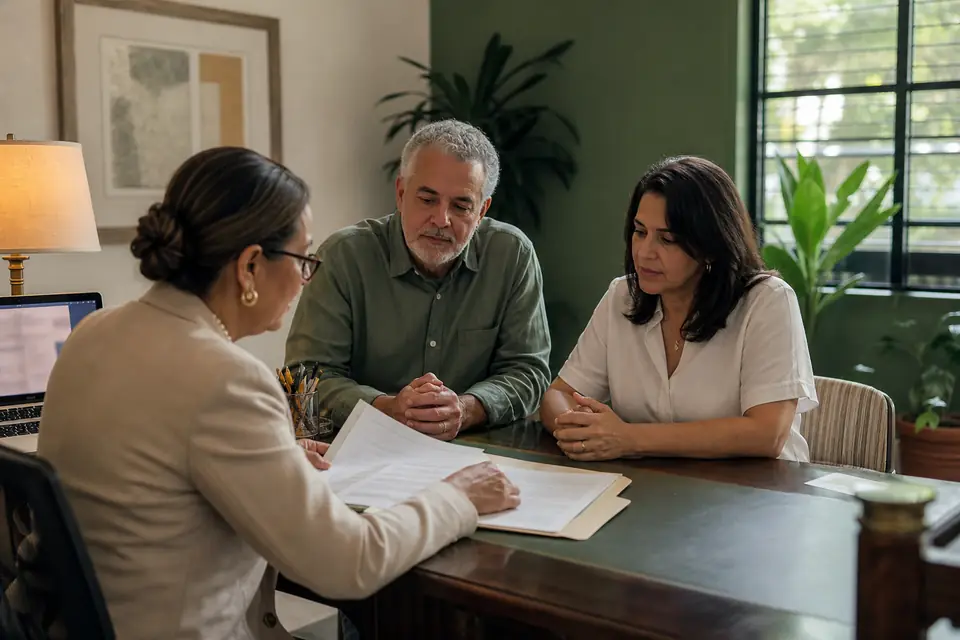
Mom's or the grandparents' house is often the most valuable asset in an estate, and also the one that stirs the most feelings. Many families decide to sell it because no one is going to live there, because the heirs live far away, or because it's the fairest way to divide things. This guide explains the steps in order, what to do if someone doesn't want to sell, and which taxes to plan for.
A few terms: the causante is the person who died; the sucesión is the estate, meaning the group of their heirs; the relevo is the certificate from the Departamento de Hacienda ("Hacienda", Puerto Rico's Treasury) that cancels the lien (the encumbrance) on the estate's property, formally the Certificación de Cancelación de Gravamen; and the partición is the division of the property among the heirs.
The steps, in order
- Confirm who the heirs are. If there was a will, you use the will together with the certificate from the Registro de Testamentos (wills registry). If there wasn't, you need a declaratoria de herederos (declaration of heirs), done before a notario (in Puerto Rico a notary is an attorney) or in court.
- File the estate information return and get the relevo. For deaths since 2018, the estate information return (Form SC 2800 C) is filed in SURI (Hacienda's online system), and you request the relevo. Without the relevo, no notary can authorize the sale of an estate asset and no registrar can record it (Internal Revenue Code, Section 2054.05). See Hacienda's lien release (relevo).
- Bring the CRIM up to date. The return requires a certificate from the CRIM (Municipal Revenue Collection Center) showing there is no debt, and the Registro de la Propiedad (Property Registry) won't record an award of the property while property taxes remain unpaid (Municipal Code, Art. 7.063).
- Record the heirs' rights. The Property Registry follows the principle of successive chain of title (tracto sucesivo): the deceased's title and the inheritance right must be on record first, and then the sale (Law 210-2015, Art. 134). If the declaration of heirs or the will doesn't describe the house, a petition (instancia) is submitted with it (Art. 126). See recording inherited property.
- Sign the deed of sale with all the heirs. Everyone appears, in person or through someone holding their power of attorney.
Selling as an estate or dividing first
Direct sale by the estate. The heirs can sell the house together to a third party without doing the partition first. Law 210-2015 provides that no award to individual heirs is needed when all the heirs sell the entire inheritance right to a third party (Art. 131). The money is then divided according to each person's share.
Awarding the house first. Another option is to do the partition, award the house to one of the heirs, who compensates the others, and let that person decide whether to sell it or keep it. See dividing the estate (partition).
If there was a surviving spouse. If the house was community property, half belongs to the spouse in their own right and the other half is part of the estate. The widow or widower signs in both capacities. The spouse can also ask to be given the family home on a preferential basis (Art. 1625), something to keep in mind before listing the house for sale.
If one heir doesn't want to sell
The whole house needs everyone's yes. Each heir can sell their own share without the others' consent, but specific assets of the estate can be sold only with everyone's consent (Art. 1604).
Options when there is no agreement:
- Buy their share, or have them buy the others' shares.
- Sell a share. If an heir sells their share to an outsider, the others have a 30-day right of first refusal (derecho de tanteo), meaning a preference to buy it on the same terms (Art. 1605).
- Ask for a partition. Any heir can ask for one at any time (Art. 1775). If there is no unanimous agreement, the partition is done in court (Art. 1780).
- Agree to wait. The heirs can agree not to divide for up to 4 years, which can be extended (Art. 1608).
If any of the heirs are minors, their share can be sold only with the court's authorization; see minors as heirs. For more serious disagreements, see disputes among heirs.
Debts: CRIM and mortgage
The CRIM. Property tax for the current year and the 5 previous fiscal years is a first lien on the property (Municipal Code, Art. 7.057). Also, anyone who acquires real estate through an inheritance must notify the CRIM of the change of owner within 30 days (Art. 7.052); if they don't, they may be liable for bills issued in the previous owner's name.
The mortgage. The mortgage doesn't disappear with the death: it remains a lien on the house. It is usually paid from the sale proceeds at closing. The heirs are liable for the deceased's debts only up to the value of what they receive (Art. 1587).
Three siblings sell their mother's house for $230,000. Selling costs, estimated at 6% of the price, come to $13,800. There is a remaining mortgage of $42,000 and a CRIM debt of $1,850. After paying those items, $172,350 is left, or $57,450 for each sibling, before taxes and other estate expenses.
Capital gains and tax basis
The tax basis is, in simple terms, the cost the law recognizes for calculating your gain when you sell. The lower the basis, the larger the taxable gain.
Deaths since January 1, 2018: carryover basis in Puerto Rico. For property inherited from someone who died after December 31, 2017, the heir's basis in Puerto Rico is the same as the deceased's. There is no adjustment to market value (Section 1034.02(a)(5)(D)). That's why Form SC 2800 C asks for the deceased's basis in each asset. Keep the purchase deed and the documents that prove it.
Deaths from 2011 to 2017. The rules are different: depending on the case, the basis is the market value on the date of death, or the deceased's basis increased by a portion of the $1,000,000 exemption, without exceeding market value (Section 1034.02(a)(5)(C)). For deaths before 2011, consult an accountant.
The federal rule is different. For IRS purposes, inherited property takes as its basis the market value on the date of death (26 U.S.C. § 1014). This matters if you have federal tax obligations on the sale, for example because you live in a state.
Doña Rosa bought her house in 1998 for $70,000 and died in 2024, when the house was worth about $210,000. Her three children sell it in 2026 for $230,000, with selling costs of $13,800.
- Gain using Puerto Rico's carryover basis: $230,000 − $13,800 − $70,000 = $146,200, about $48,733 per sibling.
- Gain using the federal basis (value at death): $230,000 − $13,800 − $210,000 = $6,200.
The difference is huge. Before you set a price or divide the money, talk to an accountant.
More details in taxes of the estate.
Heirs who don't live in Puerto Rico
The buyer must withhold. When a nonresident sells real estate in Puerto Rico, the buyer is required to deduct and withhold tax at the source on what they pay the seller. If the buyer doesn't, Hacienda can collect that amount from the buyer, unless the nonresident seller pays the tax (Section 1062.08(g); Internal Revenue Information Bulletin 22-01).
The transfer return. The person transferring the property completes and delivers to the notary's office the Planilla Informativa sobre Segregación, Agrupación o Traslado de Bienes (informational return on the segregation, grouping or transfer of property) (BI RI 22-01).
How much is withheld depends on each seller's situation. Ask the notary and your accountant to calculate it ahead of time. If you live elsewhere, also read heirs living outside Puerto Rico.
Frequently asked questions
Can I sell the house before I have the relevo?
No. Without Hacienda's relevo, a notary can't authorize the sale of an estate asset. If there are tax debts, Hacienda offers a conditional authorization to sell the property and use the money to pay them (Section 2054.02(b)).
Do we have to record the house in the heirs' names before selling it?
The Registry follows the successive chain of title: the heirs' rights must be on record before the sale is recorded. You don't always need to do the partition first if everyone sells together to a third party.
What happens to the money if one heir has personal debts?
An heir's personal creditors can't step in until the deceased's debts and the bequests are paid, but they can ask that whatever is left for that heir be held back or seized (Art. 1585).
Who pays the CRIM while the house is being sold?
The tax keeps accruing. The practical approach is for the heirs to agree in writing on who pays and how that person will be reimbursed when the sale money is divided.
Sources
- Código Civil de Puerto Rico de 2020, Arts. 1587, 1604–1608, 1625 y 1775–1780. bvirtualogp.pr.gov
- Ley del Registro de la Propiedad Inmobiliaria (Ley 210-2015), Arts. 126, 131 y 134. lexjuris.com
- Código de Rentas Internas de 2011, Secciones 1034.02(a)(5), 2054.02 y 2054.05. bvirtualogp.pr.gov
- Departamento de Hacienda, Boletín Informativo de Rentas Internas 22-01 (retención a no residentes). hacienda.pr.gov
- Código Municipal de Puerto Rico (Ley 107-2020), Arts. 7.052, 7.057 y 7.063. lexjuris.com
- Código de Rentas Internas federal, 26 U.S.C. § 1014. law.cornell.edu
CaudalRelicto.com is an independent guide. It is not Puerto Rico's Departamento de Hacienda, the courts or any government agency. This page is general information, not legal advice from an attorney who knows your case. Names and figures in examples are hypothetical. Found an error? Tell us.