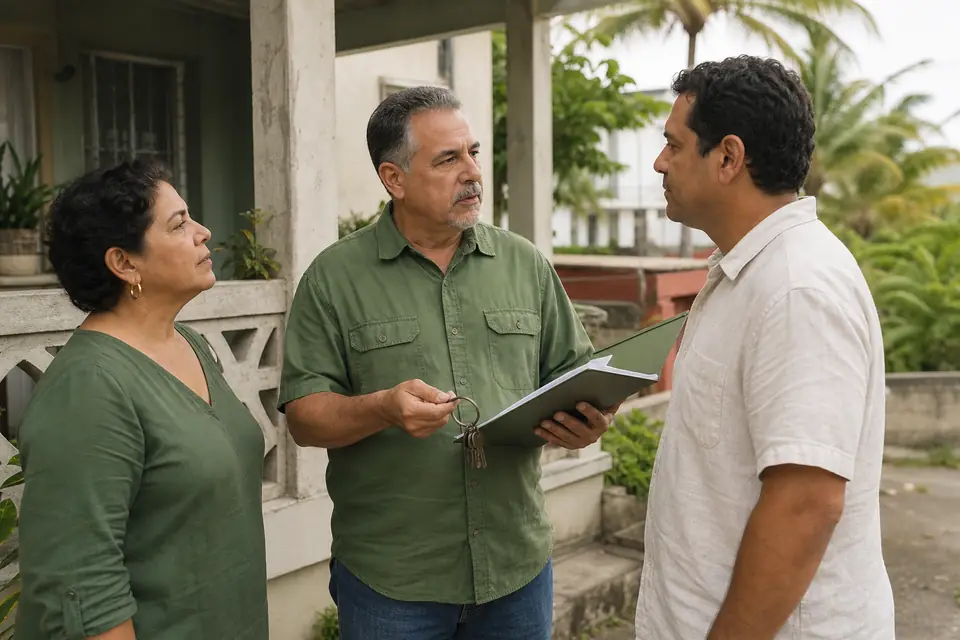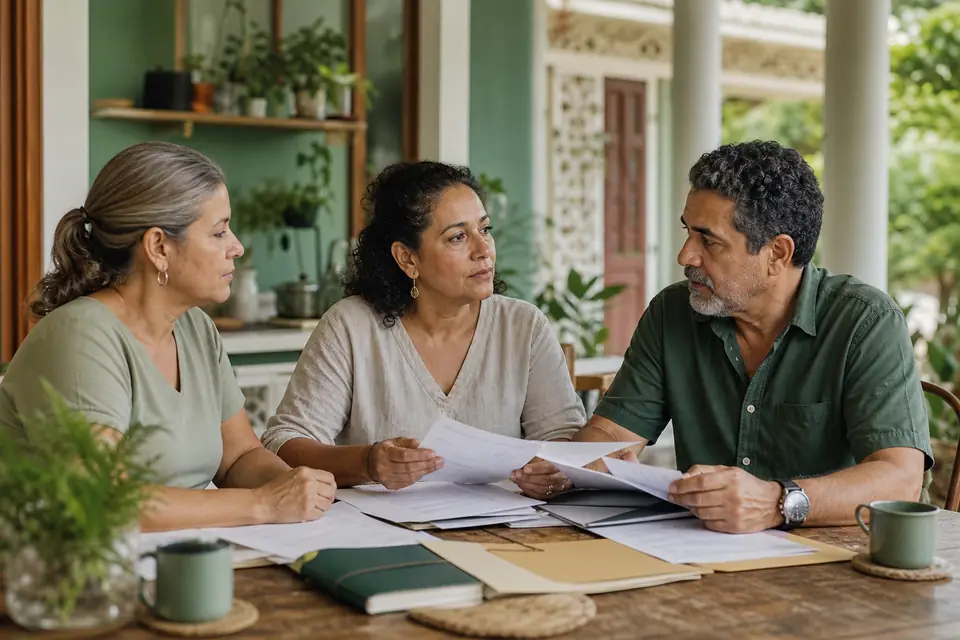
Inheritances rarely divide a family over money alone. Behind each disagreement there is usually history: who took care of Mom, who stayed on the island, who left. This guide can't heal those wounds. But it can explain what the law says about the most common disputes, and what paths exist before anyone goes to court.
First, two concepts. The comunidad hereditaria (co-ownership among heirs) is the situation the heirs are in from the death until the estate is divided: each one holds a share of the whole, but no specific asset belongs to any one of them alone (Art. 1599 of the Código Civil de Puerto Rico de 2020, the 2020 Civil Code). The partición (division of the estate) is the act that ends that co-ownership and assigns specific assets to each heir. See the estate and co-ownership among heirs.
One heir lives in the house and doesn't pay
This is the most common dispute. A sibling stayed on in the parents' house, sometimes because they were caring for them, and the others feel that person is benefiting from something that belongs to everyone.
What is clear. The house belongs to the co-ownership among heirs until the partition. The fruits of the estate, such as rent, belong to the estate until it is divided (Art. 1603). If the house is rented to someone outside the family, the money doesn't belong to whoever collects it. It belongs to everyone.
What depends on each case. Whether the person living in the house should compensate the others, and from when, depends on any agreements you had, the expenses that person paid and other circumstances. It is not an automatic calculation.
If the person living there is the surviving spouse. The situation is different. The widow or widower owns half of the community property, can ask to be given the family home on a preferential basis and, in some cases, may have a free lifetime right to live there (Arts. 541–542 and 1625). See the rights of the surviving spouse.
What to do. The healthiest approach is to put it in writing: who lives there, until when, who pays the CRIM (Municipal Revenue Collection Center) property tax, the insurance and the repairs, and whether there will be any compensation when the estate is divided.
One heir won't sign
Why their signature matters. Each heir can sell their own share, but specific assets of the estate can be sold only with everyone's consent (Art. 1604). A single person can stop the sale of the house.
If they haven't said whether they accept the inheritance. Once 30 days have passed since the estate was opened, any interested person can ask the court to give that heir a deadline of no more than 30 days to accept or refuse it. If they don't answer, the inheritance is treated as accepted (Art. 1578).
If they accept but don't want to sell. The options are to buy their share, sell them the others' shares, or ask for a partition. If an heir sells their share to an outsider, the others have 30 days to exercise a right of first refusal (derecho de tanteo), meaning a preference to buy it on the same terms (Art. 1605). If the heir who won't sign lives elsewhere and simply doesn't respond, see heirs living outside Puerto Rico.
Expenses paid by just one person
They are charges on the estate. The costs of preserving and managing the property are estate charges (cargas hereditarias), just like the funeral and the costs of the inventory and partition (Art. 1589). This means that, in principle, the estate bears them, not one person alone.
Keep everything. Receipts for the CRIM, the insurance, electricity and water, and repairs. Without proof, it is very hard to get credit for an expense when the estate is divided.
Ana, Pedro and Sonia inherit their mother's house in equal shares. Over one year, Ana paid $1,200 in CRIM, $1,500 in insurance and $3,300 in roof repairs, a total of $6,000. Each sibling's share is one third, $2,000. When the accounts are settled in the partition, Ana has grounds to ask for credit for the $4,000 she paid on behalf of her siblings.
If the house had also been rented for $850 a month, the year's $10,200 would belong to the estate, $3,400 per sibling before subtracting expenses, even if only one of them had collected it.
Mediation: talking with help
What it is. In mediation, a neutral person helps the parties talk and look for an agreement. The mediator doesn't decide for them.
The Judiciary's service. The Judiciary's Negociado de Métodos Alternos para la Solución de Conflictos (Bureau of Alternative Dispute Resolution Methods) oversees the Centros de Mediación de Conflictos (Conflict Mediation Centers), which offer their services free of charge. Participation is voluntary, and the court can also refer a case to mediation. The types of disputes they handle include family and community disputes. You can apply through the Tribunal Electrónico (the courts' e-filing system) or ask for guidance by writing to mediacion@poderjudicial.pr. Ask whether your situation is one they handle, because the official page doesn't expressly mention inheritances. More information, in Spanish, at poderjudicial.pr.
Private mediators. The Judiciary also certifies professionals as mediators. A private mediator can be helpful if the heirs live in different places or want more flexible sessions.
Why it's worth it. A mediated agreement usually costs less, takes less time and does less damage to family relationships than a lawsuit.
The estate administrator
While no one has accepted. The estate is managed by the person the causante (the deceased person whose estate it is) designated; if they designated no one, by the albacea (executor); if there is no executor, by those called to inherit; and if they can't agree, by a provisional administrator appointed by the court (Art. 1563).
The administrator. If the deceased didn't designate one, the heirs appoint the administrator, and if they can't agree, the court does (Art. 1743). When choosing, the court follows this order of preference: spouse, heirs, executor, relatives and creditors (Art. 1745).
Their duties. The administrator must begin the inventory within 30 days of accepting the role and finish it within the following 60 days (Arts. 1765–1766). Their pay can't exceed 10% of the income or net proceeds of the estate (Art. 1761). The court can also order urgent measures to preserve the property (Art. 1602). See the executor (albacea).
Accounting
It is mandatory for those managing the estate. The executor, the administrator and anyone else carrying out these duties must give quarterly accountings and a final accounting 3 months after finishing. They cannot be excused from this obligation (Art. 1767).
If an heir handles things without being appointed. If a sibling collects rent or pays the estate's bills, the prudent thing is for them to keep a clear record. Remember that the fruits belong to the estate (Art. 1603).
When there's no other way: a court-ordered partition
No one is required to remain co-owners. Any heir can ask for a partition at any time (Art. 1775), and that right to sue doesn't expire, unless there is an agreement not to divide (Art. 1205). The heirs can agree not to divide for up to 4 years, which can be extended (Art. 1608).
If there is no unanimous agreement, the partition is done through the courts, as provided by procedural law (Art. 1780). The court can also appoint a contador partidor (estate divider), the person who does the accounting and proposes the division (Art. 1748).
What can happen to the house. In a partition, an asset can be awarded to one of the heirs, who compensates the others, or sold so the money can be divided. See dividing the estate (partition) and selling an inherited house.
Frequently asked questions
Can I change the locks on the inherited house?
Until there is a partition, the house belongs to all the heirs. Changing the locks to shut out another heir usually makes the conflict worse. Look for a written agreement or get guidance first.
Can my brother rent out the house without asking me?
Rent belongs to the estate until the partition (Art. 1603), not to whoever collects it. Also, decisions about the estate's property should be made by everyone together. If there is no agreement, you can ask for an administrator.
Is mediation mandatory?
Generally, no. At the Judiciary's Conflict Mediation Centers participation is voluntary, although the court can refer a case to mediation.
How long does a court-ordered partition take?
It depends on the court, how many assets and heirs there are, and how much the parties disagree. There is no fixed timeline. That's why it's worth trying to reach an agreement first.
Can I sell my share to an outsider to get out of the situation?
Yes, you can sell your share without the others' consent (Art. 1604). But your co-heirs have 30 days to exercise their right of first refusal and buy it on the same terms (Art. 1605).
Sources
- Código Civil de Puerto Rico de 2020, Arts. 1563, 1578, 1589, 1599–1608, 1743–1767 y 1775–1780. bvirtualogp.pr.gov
- Poder Judicial de Puerto Rico, "Centros de Mediación de Conflictos". poderjudicial.pr
- Poder Judicial de Puerto Rico, "Negociado de Métodos Alternos para la Solución de Conflictos". poderjudicial.pr
- Código Civil de Puerto Rico de 2020, Arts. 541–543 y 1625 (vivienda familiar y cónyuge). bvirtualogp.pr.gov
CaudalRelicto.com is an independent guide. It is not Puerto Rico's Departamento de Hacienda, the courts or any government agency. This page is general information, not legal advice from an attorney who knows your case. Names and figures in examples are hypothetical. Found an error? Tell us.