Making a will is one of the clearest ways to take care of your family. It lets you decide who receives your property, name a trusted person to carry out your wishes and spare your loved ones from having to obtain a declaratoria de herederos (declaration of heirs).
In Puerto Rico, most people sign a testamento abierto (will executed before a notary). Keep in mind that a notario in Puerto Rico is an attorney. This guide explains what to decide before your appointment, what documents to bring, what the process is like and how to change your will later. If you want to compare the other options, see the types of wills.
Step 1: make a list of your property and debts
Before deciding who receives what, it helps to know what you have. Write down:
- houses, lots and farms (with the cadastral number if you have it);
- bank and credit union (cooperativa) accounts, investments and retirement accounts;
- vehicles, businesses and shares in corporations;
- items of family or sentimental value;
- mortgages, loans and other debts.
If you are married under the sociedad legal de gananciales (community property regime), remember that half of the community property belongs to your spouse. You can dispose of only your share by will (Art. 530). If you leave a specific community asset in your will and in the end it isn't awarded to your estate, only your share in it or its value is considered left to that person. We explain this in community property and inheritance.
Life insurance and accounts with a beneficiary. The Supreme Court has held that the amount of a life insurance policy is not part of the caudal relicto (the decedent's estate), because the beneficiary acquires a right of their own. Check that your designated beneficiaries match what you want (Vélez Rivera v. Bristol-Myers Squibb, 2002 TSPR 123).
Step 2: understand the forced share and the free portion
This is the most important decision. The legítima (forced share) is the part of the estate that the law reserves for certain people called forced heirs (legitimarios) (Art. 1621). The forced heirs are:
- descendants (children and, by representation, grandchildren);
- the surviving spouse; and
- if there are neither, parents and other ascendants (Art. 1622).
If you have forced heirs, the forced share is half of your estate and the other half is the free portion (libre disposición): you can leave it to anyone you want, including one of your children, your unmarried partner or an institution. If you have no forced heirs, you can dispose of everything (Art. 1623). The forced half is divided among the forced heirs according to the rules for inheritance without a will: the children and the spouse, in equal shares (Arts. 1624, 1721).
Luis, age 58, is married to Ana and has two children, Gabriel and Sofía. After setting aside the half of the community property that belongs to Ana, Luis's estate is worth $300,000.
- Forced share (half): $150,000, divided into three equal parts among Ana, Gabriel and Sofía: $50,000 each.
- Free portion: $150,000. Luis can leave all of it to Sofía, who takes care of him, to his brother or to a church.
Luis can't leave Gabriel less than $50,000 in total, unless he disinherits him for a cause recognized by law. If he did, Gabriel could ask for the rest of his forced share to be made up (Art. 1630).
You can do your own calculation here:
Three rules worth knowing:
- You can't place conditions, usufructs (rights to use and receive income) or prohibitions on the forced share; such burdens are treated as if they had never been written. You can place them only on what you leave from the free portion (Art. 1626).
- Your spouse can ask to be given the family home on a preferential basis (Art. 1625).
- To take away someone's forced share, you must disinherit them in your will for a cause recognized by law, stated clearly (Arts. 1632–1637).
More details, including disinheritance, in our guide to the forced share (legítima).
Step 3: choose the people who will carry out your wishes
Executor. The albacea (executor) is the person you designate to carry out your will or oversee that it is carried out (Art. 1739). Choose someone organized, trustworthy and fully able to take on legal obligations (Art. 1729). You can name a substitute (Art. 1738), set their pay (Art. 1761), excuse them from posting a bond (Art. 1757) and authorize them to sell property, something that without your authorization would require the unanimous consent of the heirs or a court (Art. 1741). We explain it all in the executor (albacea).
Estate divider. The contador partidor is the person who divides the property and assigns it to the heirs (Art. 1747). It can be the same person as the executor or someone else.
Guardian for your minor children. Parents with parental authority (patria potestad) can name in their will a guardian for their minor children, or for an adult child who is legally incapacitated, in case both parents die or can't care for them (Art. 126). You can name substitutes and different guardians for each child (Art. 127). The court will evaluate the person's suitability before they take on the role (Art. 125). You can also name a guardian just to manage the property you leave your child (Art. 126). See minors as heirs.
Other instructions. A will can also include non-financial provisions, such as acknowledging a child (Arts. 1639, 1717) or how you want your body to be handled (Art. 80).
Step 4: gather the documents
Each notary will tell you exactly what they need, but it's usually helpful to bring:
- a current photo ID;
- full names, dates of birth and addresses of your spouse, children and anyone else you want to include;
- your marriage certificate, divorce judgment or prenuptial agreement (capitulaciones matrimoniales), if applicable;
- information about your properties (deeds, cadastral numbers, accounts);
- the names of the executor, the estate divider and the guardian, and their substitutes;
- any earlier will.
Step 5: the appointment with the notary
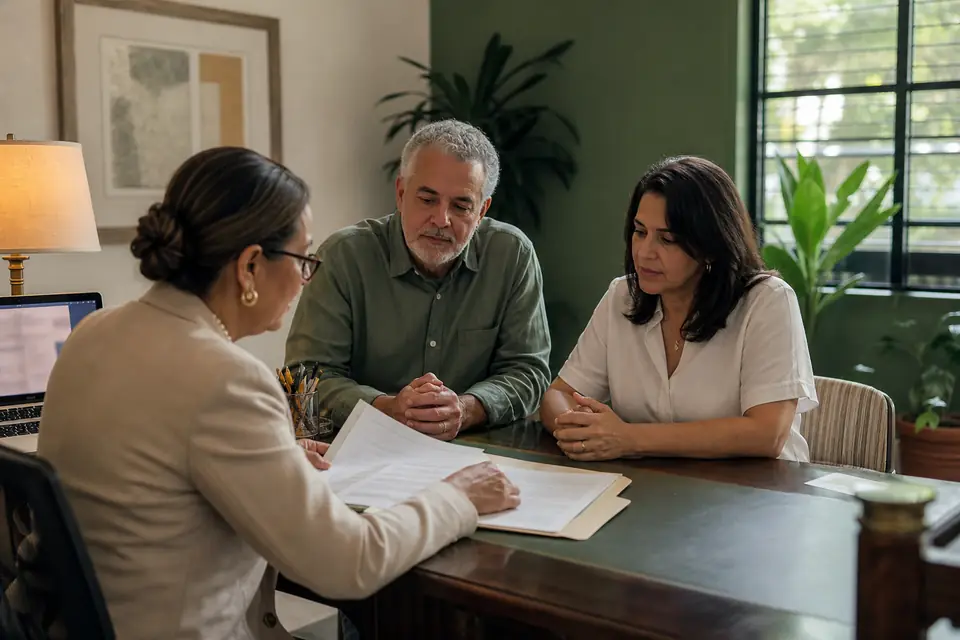
- Interview. The notary listens to what you want, explains the limits of the forced share and asks you questions about your family and your property.
- Draft. The notary prepares the text of the deed. Review it calmly.
- Signing. The will is read, you confirm it reflects your wishes and you sign it. The notary records the time (Art. 1647) and attests that, in their judgment, you have the capacity to make a will (Art. 1648).
- Witnesses, only if you or the notary ask for them, or if you can't read or sign (Art. 1644).
- Registry. The original stays in the notary's secret protocol (Notarial Law, Art. 47), and the notary reports it to the Registro de Testamentos (Wills Registry) of ODIN (Office of Notarial Inspection) on the next business day (Notarial Law, Art. 73).
You can ask for a certified copy. While you are alive, no one else has a right to a copy of your will (Notarial Law, Art. 43). Tell your executor or a family member that the will exists and which notary you signed it with.
Cost. The notary's fees are agreed with them, and there are also fees and stamps to pay. There is no single official rate we can cite, so ask for a written estimate.
How to change or revoke your will
A will is, by its nature, revocable (Art. 1639). It can be revoked in three ways (Art. 1711):
- Expressly: a later will states that it cancels the earlier one, in whole or in part (Art. 1712).
- Implicitly: the later will contains provisions that are incompatible with those of the earlier one (Art. 1713).
- Physically: the person who made it tears up or destroys their testamento ológrafo (handwritten will) (Art. 1715). An open will is not revoked by tearing up a copy; you need another will.
Other useful rules: divorce or annulment of the marriage revokes what you left to your former spouse (Art. 1714). If you revoke the will that revoked another one, the first one doesn't come back into effect unless you say so expressly (Art. 1716). And acknowledging a child in a will is not lost even if the will is revoked (Art. 1717).
When to review it: when you marry or divorce, when a child or grandchild is born or dies, when you sell or buy a house, if you move away from Puerto Rico, or if your executor can no longer serve. If your will was made before November 28, 2020, review it: the new Code eliminated the mejora (the extra share a parent could leave to certain descendants) and changed the portions of the forced share.
Wills executed outside Puerto Rico
Many families have members in the United States or in other countries. These are the Code's basic rules:
- Form: a will is valid as to form if it complies with Puerto Rico law, the law of the place where it was executed or the law of the testator's domicile at the time (Art. 65).
- Capacity: it is recognized if the testator had capacity under Puerto Rico law or the law of their domicile (Art. 64).
- Forced share on real estate on the island: the inheritance is governed by the law of the deceased's domicile, but Puerto Rico's forced share rules apply to all real estate located here (Art. 62).
- Joint will: even if another state allows two people to make a will in the same document, that will has no effect on real estate in Puerto Rico (Art. 1640).
- Handwritten will: a person domiciled in Puerto Rico can make one outside the island even if the law of that place prohibits it (Art. 1651).
A notarial document executed outside Puerto Rico must be notarized and filed into a notary's protocol here (protocolizarse) to have the effect of a public instrument (Notarial Law, Art. 38). If you live elsewhere and own a house in Puerto Rico, the safest course is to consult a notary here before signing. See also heirs living outside Puerto Rico.
Frequently asked questions
At what age can I make a will in Puerto Rico?
From age 14, if you have enough judgment to understand what you are doing (Art. 1641). A handwritten will requires you to be 18.
Can I leave everything to my wife and nothing to my children?
Not entirely. Your children and your wife are forced heirs and share the forced half in equal parts. You can leave your wife the free portion in addition to her forced share, but you can't take away your children's portion, except through a valid disinheritance (Arts. 1623–1624, 1632).
Can I leave property to my partner if we aren't married?
Yes, from the free portion. An unmarried partner doesn't inherit by law without a will, which is why a will is so important in your case.
Do I have to go back to the notary if I change my mind?
To change an open will, you need to sign a new one, which can revoke the earlier one in whole or in part (Arts. 1712–1713). Tearing up your copy doesn't revoke it.
Where is the original kept?
In the protocol of the notary who executed it. The notary reports it to the Wills Registry, and after your death your family can locate it with a will search certificate.
Sources
- Código Civil de Puerto Rico de 2020 (Ley 55-2020), Arts. 62–65, 80, 125–129, 530, 1622–1626, 1640–1649, 1711–1718, 1739–1767, compilación OGP Rev. 21 de agosto de 2026. bvirtualogp.pr.gov
- Tribunal Supremo de Puerto Rico, Vélez Rivera v. Bristol-Myers Squibb, 2002 TSPR 123. dts.ramajudicial.pr
- Ley Notarial de Puerto Rico (Ley 75-1987), Arts. 38, 43, 47 y 73, compilación OGP Rev. 27 de agosto de 2026. bvirtualogp.pr.gov
- Castrodad García, "Nuevo código, nuevos retos - los fideicomisos testamentarios y los cambios en el Derecho Sucesorio", 91 Rev. Jur. UPR 1083 (2022). derecho.uprrp.edu
CaudalRelicto.com is an independent guide. It is not Puerto Rico's Departamento de Hacienda, the courts or any government agency. This page is general information, not legal advice from an attorney who knows your case. Names and figures in examples are hypothetical. Found an error? Tell us.