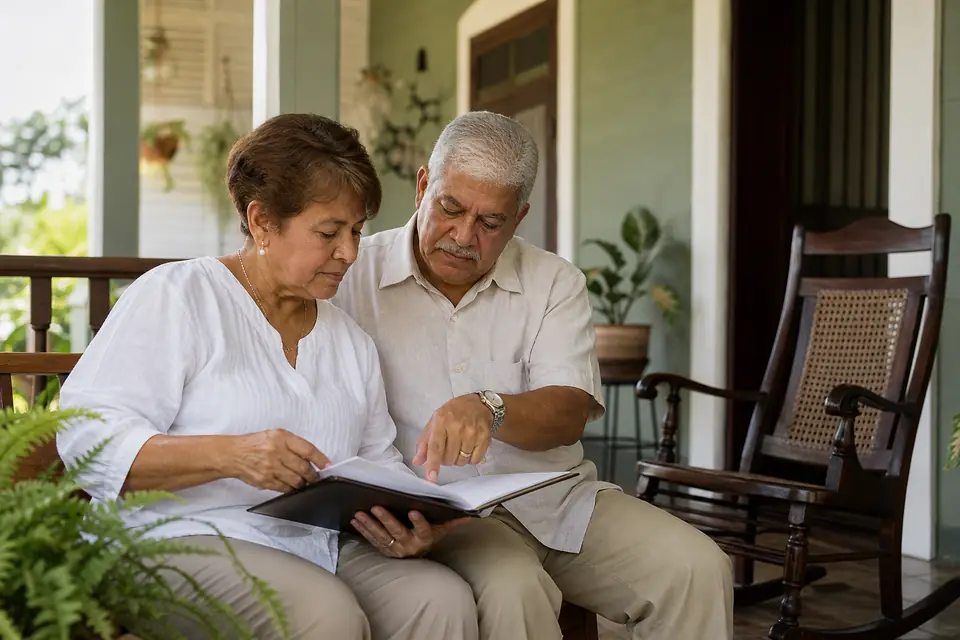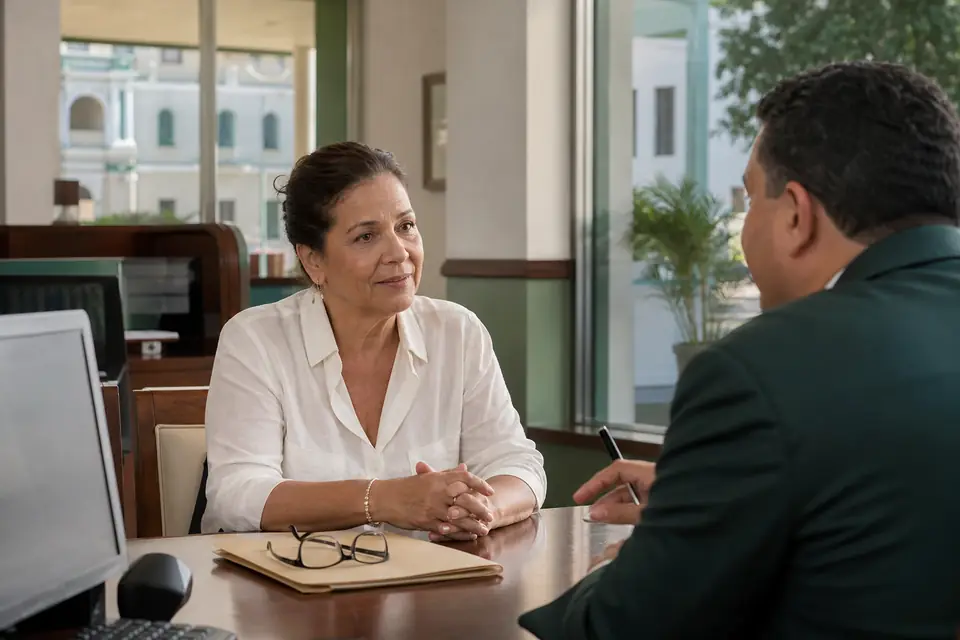
One of the first surprises for many families is arriving at the bank with the death certificate and hearing that they cannot withdraw all the money. It is not the bank being difficult. Puerto Rico law limits how much banks and insurers can release before the Departamento de Hacienda (Puerto Rico's Treasury) issues the relevo (Hacienda's lien release, formally the Certificación de Cancelación de Gravamen).
Why the bank holds the money
When a person dies, all of their property becomes subject to a lien in favor of the Government of Puerto Rico, which guarantees payment of any outstanding tax (Section 2054.01). That lien is canceled with Hacienda's relevo, which you obtain by filing the estate information return. See Hacienda's lien release.
Until there is a relevo, Section 2054.05 of the Código de Rentas Internas (Internal Revenue Code) caps what financial institutions and insurers can release.
What a bank can release without the relevo
Banks, credit unions (cooperativas), savings associations, investment trusts and brokerage firms cannot release to the heirs more than $15,000 or 25% of the funds, whichever is greater. To release more, they need the relevo or an authorization from Hacienda.
In practice:
- If the account holds $15,000 or less, the limit does not prevent releasing the entire balance.
- Between $15,000 and $60,000, the cap is $15,000, because 25% is less.
- Above $60,000, the cap is 25%, because it is already more than $15,000.
Three hypothetical cases of money in a credit union:
- Don Julio left $8,000. The $15,000 cap is greater than the balance, so the credit union can release the full $8,000.
- Doña Lydia left $40,000. 25% would be $10,000, but the greater amount is $15,000. The heirs can receive $15,000 without the relevo, and the other $25,000 waits.
- Don Ramón left $100,000. 25% is $25,000, which is more than $15,000. The heirs can receive $25,000 without the relevo, and the other $75,000 waits.
The law does not explain in detail how the calculation works when there are several accounts or several institutions. Each bank has its own procedure, and it may ask for the declaratoria de herederos (declaration of heirs) or the will to know whom to pay. Ask how they apply it in your case.
In addition, the institution must notify Hacienda in writing, within 30 days of each payment, whom it paid, how much and how much remains outstanding (Section 2054.05(b)).
Joint accounts have a limit too
This point confuses many people. The law says expressly that the limit applies to accounts in the name of the deceased and to those they held jointly with another person (Section 2054.05(a)(2), as amended by Act 76-2017).
So if you shared an account with your father or your wife, the bank can limit what you withdraw until there is a relevo, even though your name is on the account.
Ivelisse had a $60,000 joint account with her mother, who died in June. 25% of $60,000 is $15,000, the same as the minimum. Without the relevo, the bank can release $15,000. The other $45,000 waits for Hacienda's relevo.
Who truly owns the money in a joint account is a separate question. The Civil Code does not regulate these accounts, and the answer may depend on the contract with the bank and on who contributed the money. If there is disagreement in the family, seek guidance.
What an insurer can pay without authorization
Insurers cannot pay without Hacienda's authorization, except up to $5,000 or 40% of the policy's total value, whichever is greater (Section 2054.05(a)(4)).
- On a policy of $12,500 or less, the cap is $5,000, or the full amount if the policy is smaller.
- On a policy of more than $12,500, the cap is 40%.
Luis is the beneficiary of his father's $50,000 policy. 40% is $20,000, which is more than $5,000. Without Hacienda's authorization, the insurer can pay him $20,000. On a $10,000 policy, 40% would be $4,000, so the cap would be $5,000.
Policies with a designated beneficiary. The Supreme Court ruled in 2002 that life insurance proceeds are not part of the decedent's caudal relicto (the decedent's estate), because the beneficiary has a right of their own. However, Section 2054.05(a)(4) is written in general terms, and we could not confirm how insurers apply it to those policies today. Ask the insurer directly. More in life insurance and beneficiaries.
Calculate how much can be released
Enter the account balance or the policy value to see the cap without the relevo:
Safe deposit boxes: Modelo SC 2655
The bank cannot allow the safe deposit box of a deceased person to be opened without a Hacienda representative present (Section 2054.05(a)(3)). Hacienda describes the procedure this way:
- Arrange a date and time with the bank.
- Write to citaaperturacaja@hacienda.pr.gov with the subject line "Cita para Apertura Caja de Seguridad" (write in Spanish if you can; Hacienda works in Spanish).
- Include the decedent's name and Social Security number, the date of death, the bank, the box number, the contact person at the bank and the date and time of the appointment.
- The Hacienda official attends the opening and prepares Modelo SC 2655, "Acta de Apertura de Caja de Seguridad" (record of the safe deposit box opening).
That record is a required attachment to the Planilla Informativa de Caudal Relicto (estate information return), and the contents of the box are reported on Schedule A (Anejo A).
Retirement accounts, 401(k) plans and pensions
Retirement accounts with a designated beneficiary are not regulated by the Civil Code. Each institution or plan pays according to its documents and the beneficiary designation.
- IRAs and individual retirement accounts. If they are at a bank, credit union or brokerage firm in Puerto Rico, the institution may apply the Section 2054.05 limit. Ask for the beneficiary claim form.
- Employer retirement plans, such as a 401(k). Contact Human Resources or the plan administrator. The plan will say who the beneficiary is and what documents it needs.
- Government of Puerto Rico pensions. The Retirement Administration (Administración de los Sistemas de Retiro) has an online death notification on its portal for Government, Judiciary and teacher pensioners. The portal is in Spanish.
- Social Security. Benefits deposited for the month of death and later months must be returned. See Social Security and pensions after a death.
An account passing directly to a beneficiary does not necessarily mean it is left off Hacienda's return. If the deceased had significant retirement accounts or investments in the United States, see estates with property in the U.S..
Frequently asked questions
Can I use the money in the bank to pay for the funeral?
Current law has no special rule for the funeral: the general limit of $15,000 or 25% applies. That portion can help with the funeral and other urgent expenses. Keep the receipts, because the funeral is an estate expense.
What happens if I keep withdrawing money from the joint account after the death?
The bank must apply the limit even though your name is on the account. Also, if the money belonged to the deceased, the other heirs can make a claim against you. It is better to wait for the relevo and keep clear records.
Can the bank refuse to give me information about the account?
The bank will usually ask for the death certificate and proof that you are an heir, such as the declaration of heirs or the will. Bring certified copies and ask what else they need.
When is the rest of the money released?
When Hacienda issues the relevo. For deaths since 2018, the law says it is issued immediately if the return is complete and there are no tax debts. That is why it is wise to file early and not wait until the last month.
Sources
- Código de Rentas Internas de Puerto Rico de 2011, Secciones 2054.01 y 2054.05. bvirtualogp.pr.gov
- Ley 76-2017 (texto en inglés), Sección 15. bvirtualogp.pr.gov
- Departamento de Hacienda, Determinación Administrativa 18-09 (apertura de cajas de seguridad). hacienda.pr.gov
- Tribunal Supremo de Puerto Rico, Vélez Rivera v. Bristol-Myers Squibb, 2002 TSPR 123. dts.ramajudicial.pr
- Administración del Seguro Social, "Beneficios para sobrevivientes" (Pub. 05-10008). ssa.gov
- Administración de los Sistemas de Retiro, portal oficial. retiro.pr.gov
CaudalRelicto.com is an independent guide. It is not Puerto Rico's Departamento de Hacienda, the courts or any government agency. This page is general information, not legal advice from an attorney who knows your case. Names and figures in examples are hypothetical. Found an error? Tell us.