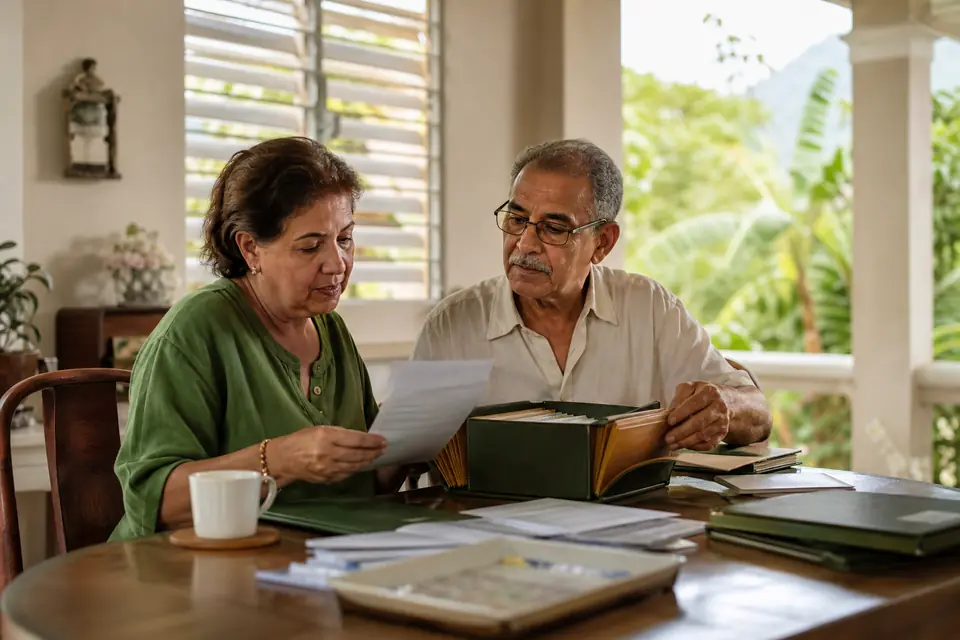
For many families in Puerto Rico, life insurance is the money that arrives first and pays the most urgent expenses. But it travels in a different lane from the inheritance: it isn't divided by the will or by the declaratoria de herederos (declaration of heirs), but by the beneficiary form you signed, sometimes many years ago.
This guide explains why, how to review your designations and what happens with retirement accounts.
Why life insurance stays outside the estate
The Código Civil de Puerto Rico de 2020 (2020 Civil Code) refers insurance contracts to special legislation (Art. 1509). Under that legislation, the Puerto Rico Supreme Court has said that the beneficiary of a policy acquires a right of their own, which arises from the contract and doesn't derive from the insured person. For that reason, "the amount of a life insurance policy is not part of the decedent's gross estate" (Vélez Rivera v. Bristol-Myers Squibb, 2002 TSPR 123).
This has three practical consequences:
- The beneficiary gets paid even if the will says otherwise. If your policy still names your brother, the money goes to your brother, even if your will talks about your children.
- The insured person's creditors can't collect from that money. The Insurance Code, as cited by the Supreme Court, protects policy benefits from the insured person's creditors and representatives. The Civil Code also makes a debtor's life insurance money exempt from seizure when the beneficiary is one of the debtor's forced heirs (Art. 1157(i)).
- The beneficiary doesn't have to wait for the partición (division of the estate) to file a claim with the insurer, although there may be a limit until there is a relevo from Hacienda (we explain this below).
How to review your beneficiaries
- Make a list of all your policies: individual policies, policies through work (group insurance), policies through your credit union (cooperativa) and policies tied to loans.
- Ask each company for confirmation of who your primary and alternate beneficiaries are, and in what percentages.
- Compare them with your will and with what you want today.
- Always name an alternate beneficiary (also called contingent), in case the primary one dies before you.
- Update the form with the insurer. A change to your will doesn't change the policy.
- Keep a copy of the updated form in the folder for your family (see estate planning basics).
Review especially after a divorce. The Civil Code revokes provisions of a will in favor of a former spouse (Art. 1714), but that rule talks about wills, not insurance policies. Don't assume your former spouse is no longer your beneficiary: check with the insurer.
If the beneficiary is a minor, the money will be managed by their parents or guardian, with limits: for example, they need court authorization to sell or mortgage the minor's real estate or personal property worth more than $2,000 (Art. 632). If you'd rather choose who manages it, you can name a guardian just for that property (Art. 129) or use a trust (see trusts in Puerto Rico and minors as heirs).
What happens if the beneficiary died before you
It depends on what the policy says. In general terms:
- If there is a living alternate beneficiary, the money is paid to that person.
- If there were several primary beneficiaries and one died, the policy usually says whether their share is divided among the others or passes to someone else. Read that clause.
- If no beneficiary is left, what happens depends on the policy's terms. If the money ends up being paid to your sucesión (the estate / the group of heirs), then it would be part of the inheritance, and your family would need the will or a declaration of heirs to collect it.
That's why the alternate beneficiary is so important: it keeps the insurance from getting caught up in the estate process.
How much the insurer can pay without Hacienda's relevo
The relevo is the certificate from the Departamento de Hacienda ("Hacienda", Puerto Rico's Treasury) that cancels the tax lien on the deceased person's property, formally the Certificación de Cancelación de Gravamen (see Hacienda's lien release (relevo)). The Internal Revenue Code says insurers may not pay without Hacienda's authorization, except up to $5,000 or 40% of the policy's total value, whichever is greater (Sec. 2054.05(a)(4)). The insurer must notify Hacienda of each payment within 30 days.
Rosa is the beneficiary of her mother's life insurance.
| Policy value | 40% of value | What can be paid without relevo | What remains pending |
|---|---|---|---|
| $50,000 | $20,000 | $20,000 | $30,000 |
| $10,000 | $4,000 | $5,000 | $5,000 |
| $8,000 | $3,200 | $5,000 | $3,000 |
With the $50,000 policy, 40% is more than $5,000, so $20,000 can be paid. With the smaller policies, the $5,000 minimum applies.
The tax law refers to insurers in general terms, and we have not found recent guidance from Hacienda explaining how this limit applies to policies with a designated beneficiary. Ask the insurer from the start whether it will require the relevo or an authorization from Hacienda to pay the rest. For people who died in 2018 or later, the relevo is requested with the estate information return in SURI (Hacienda's online system).
Retirement accounts and employer plans
Qualified retirement plans. The Trusts Act provides that the assets of a qualified retirement plan trust under the Internal Revenue Code fall outside the Civil Code's inheritance rules and are paid according to the plan documents (Law 219-2012, Art. 71). In addition (Art. 70):
- If the participant is married, their spouse is the beneficiary entitled to all the death benefits.
- The participant can name someone else only by complying with the federal ERISA law, which requires the spouse's consent in the form that law provides.
- If the plan is exempt from ERISA and the spouses agreed to complete separation of property in a prenuptial agreement (capitulaciones), that consent is not needed.
Individual retirement accounts and other accounts with a beneficiary. The Civil Code doesn't regulate them. In general, they are paid to the beneficiary you designated with the institution. Review those designations just like your insurance ones, and ask the institution what documents it will require from your beneficiaries, because banks and brokerage firms also have limits on releasing funds without a relevo (see bank accounts of the deceased).
Government of Puerto Rico pensions. The portal of the Administración de los Sistemas de Retiro (Retirement Systems Administration) at retiro.pr.gov, which is in Spanish, has services for designating beneficiaries in the Government and Judiciary systems, the Teachers system and the Law 106 plan. Check your designation there.
Social Security. Social Security survivor benefits are not assigned by a beneficiary form: they depend on federal eligibility rules. See Social Security and pensions after a death.
Frequently asked questions
Can my children claim the insurance if I left it to my partner?
The Supreme Court has said that the beneficiary's right comes before any claims the insured person's heirs might have (Fernández Vda. de Alonso v. Cruz Batiz, 128 DPR 493 (1991), cited in 2002 TSPR 123). If you want to protect your children, the surest way is to name them on the policy or divide the percentages as you wish.
Does making an advance medical directive affect my life insurance?
No. Law 160-2001 expressly says that signing or carrying out an advance directive about medical treatment does not void or affect the insured person's life insurance policy (Art. 11).
Can I name my estate as beneficiary?
Some policies allow it, but then the money goes into the estate: it is divided according to the will or the law, and your family will need to complete the estate process to collect it. If your goal is for the money to arrive quickly, it's usually better to name specific people.
Do I have to include the insurance on the estate return?
The SC 2800 C information return describes the deceased's property. Ask your accountant how to treat a policy with a designated beneficiary in your case, especially if the beneficiary is the estate. See taxes of the estate.
Sources
- Tribunal Supremo de Puerto Rico, Vélez Rivera v. Bristol-Myers Squibb, 2002 TSPR 123 (cita los Arts. 11.330 y 11.340 del Código de Seguros). dts.ramajudicial.pr
- Código de Rentas Internas de 2011, Sec. 2054.05, según Ley 76-2017. bvirtualogp.pr.gov
- Ley 219-2012, "Ley de Fideicomisos", Arts. 69–71, compilación OGP Rev. 07-ago-2026. bvirtualogp.pr.gov
- Código Civil de Puerto Rico de 2020 (Ley 55-2020), Arts. 129, 632, 1157, 1509, 1714, compilación OGP Rev. 21-ago-2026. bvirtualogp.pr.gov
- Ley 160-2001, Art. 11, compilación OGP Rev. 11-oct-2024. bvirtualogp.pr.gov
- Administración de los Sistemas de Retiro, portal oficial. retiro.pr.gov
CaudalRelicto.com is an independent guide. It is not Puerto Rico's Departamento de Hacienda, the courts or any government agency. This page is general information, not legal advice from an attorney who knows your case. Names and figures in examples are hypothetical. Found an error? Tell us.